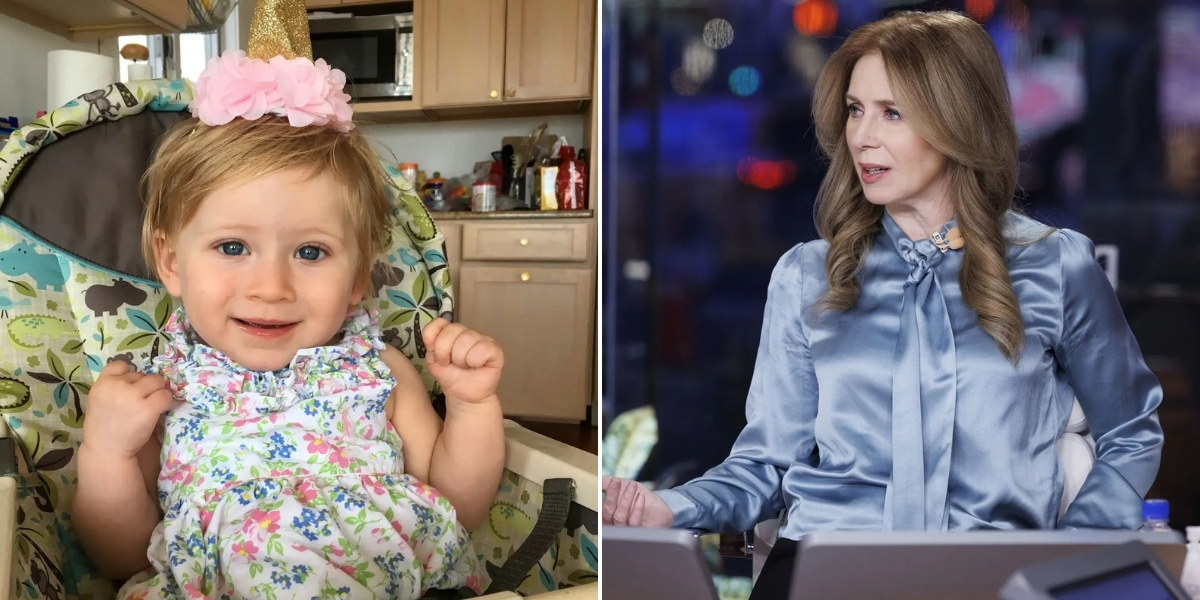
For the first time, CNBC’s Becky Quick is opening up about her daughter Kaylie’s SYNGAP1 diagnosis in an exclusive interview with PEOPLE. After keeping her daughter’s journey private for more than six years, Quick is ready to share her story.
For nearly a decade, the longtime Squawk Box co-anchor, 53, kept her 9-year-old daughter Kaylie’s rare genetic disorder out of the public eye. SYNGAP1, defined by the Children’s Hospital of Philadelphia, causes a spectrum of neurodevelopmental challenges and currently has no cure, often requiring round-the-clock care.
“I realized around 8 months that she wasn’t hitting her milestones,” Quick recalls. “Sometimes her eyes would cross. You just kind of know as a mom that something’s not quite right.” After consulting a pediatrician and a developmental specialist, Quick’s fears were confirmed: Kaylie wasn’t meeting the expected benchmarks.
:max_bytes(150000):strip_icc():focal(665x0:667x2):format(webp)/Becky-Quick-010726-1-f903b81c340c4fef88cb229f77954be4.jpg)
Quick immediately began working with therapists to support Kaylie’s development—from rolling over to walking and refining her motor skills. But soon, they noticed other challenges. A neurologist’s EEG revealed subclinical seizures, and genetic testing ultimately confirmed SYNGAP1.
“It was de novo, which means a single letter in her DNA was off at birth, and it didn’t come from me or my husband,” Quick explains. “It just happens sometimes at conception.” The family received the diagnosis just before Kaylie turned 3. “It was terrifying,” Quick says, “but also a relief to finally have a name for what was happening.”
:max_bytes(150000):strip_icc():focal(499x0:501x2):format(webp)/Becky-Quick-010726-54fedab99ae140809079c4b2f55c9797.jpg)
Like many parents in similar situations, Quick admits she struggled with guilt. “You start questioning everything—what you ate, what you did while pregnant. You blame yourself, even though it’s not your fault.” One doctor’s early prediction—that Kaylie might not become a “Fortune 500 CEO” but could potentially go to college—frustrated her. “I was mad at him for writing her off so early,” she says.
Over time, Quick realized just how much Kaylie was missing as she fell behind her peers. “It was pretty devastating,” she admits. The family leaned on each other for support, but Quick says she had to compartmentalize her emotions at work. “Being on TV, I couldn’t really share it. You feel so alone on this path, like nobody else understands.”
Her decision to go public was thoughtful. Quick wanted to ensure Kaylie was stable and getting the best care possible while exploring research opportunities that might lead to a cure. “I realized that so many families are walking this same lonely path,” she says. “If we could connect communities, share best practices, and advocate for research, we could make a real difference.”
This led to the launch of CNBC Cures, an initiative dedicated to raising awareness for the 30 million Americans living with rare diseases. The goal: a constant voice for medical advancements and a call to action.
:max_bytes(150000):strip_icc():focal(666x0:668x2):format(webp)/Becky-Quick-010726-5-64cb5f5188da4ce68efc9f82a7edb9ac.jpg)
Today, Kaylie is working hard to communicate, navigating the challenges of SYNGAP1. Quick describes the condition’s effects on her daughter: “The dendrites in her brain get overloaded. Sometimes she bites herself or others when she’s overwhelmed. ABA therapy has helped tremendously.”
:max_bytes(150000):strip_icc():focal(666x0:668x2):format(webp)/Becky-Quick-010726-4-ecb69da1d44742b6ae4b4374bd75f45d.jpg)
Kaylie attends a special needs school that integrates community outings, from Dunkin’ Donuts trips to zoo visits. For Quick, these interactions are priceless. “I want people to understand that kids like Kaylie, who may act or look differently, just want to be part of the community. They’re kids too.”